
Last Updated: November 18, 2026
Quick Summary
Water softener leads from West Jordan new construction permits come from reading the city's public permit portal and filtering for single-family homes that have passed a plumbing rough-in inspection. That stage confirms the softener loop and drain are set, so you can plan outreach around estimated move-in timing instead of buying a list.
- Filter permits to single-family only, drop recent issues, and check for a passed rough-in.
- A passed plumbing rough-in means the loop and drain are set, so quote equipment next.
- Group surviving permits by street so one drive covers several homes.
- Plan two touches per home, starting a few weeks before the estimated move-in window.
- New Home Watch's Salt Lake County list currently covers Herriman only, built from City of Herriman permits.
Table of Contents
- Why New Construction Is the Best Water Softener Lead Source in West Jordan
- How to Read West Jordan Building Permits for Water Softener Opportunities
- Turning Permit Stages into Water Softener Installation Leads
- Planning Outreach Around Estimated Move-In Timing
- Why a Water Softener Belongs in New Construction Plumbing Planning
- Using the Herriman New Construction Street List as Your Salt Lake County Test
- Get the Free Weekly Street List for Salt Lake County
- Frequently Asked Questions
Why New Construction Is the Best Water Softener Lead Source in West Jordan
Water softener leads get expensive fast when you buy them from a list broker. New construction changes the math.
The advantage is timing, not volume. New construction puts you on the street while the plumbing is still open and the first homeowner is months from turning a valve.
One definition matters here. Estimated move-in timing is the projected window when a permitted home will be close enough to finished that a finish-out trade can plan a visit.
Watch out: the biggest mistake is treating a permit date as a move-in date.
How to Read West Jordan Building Permits for Water Softener Opportunities
Start with the city's own permit search, not a third-party aggregator. West Jordan publishes residential building permits through its online permit portal, and that record is the source of truth for what is being built and where.
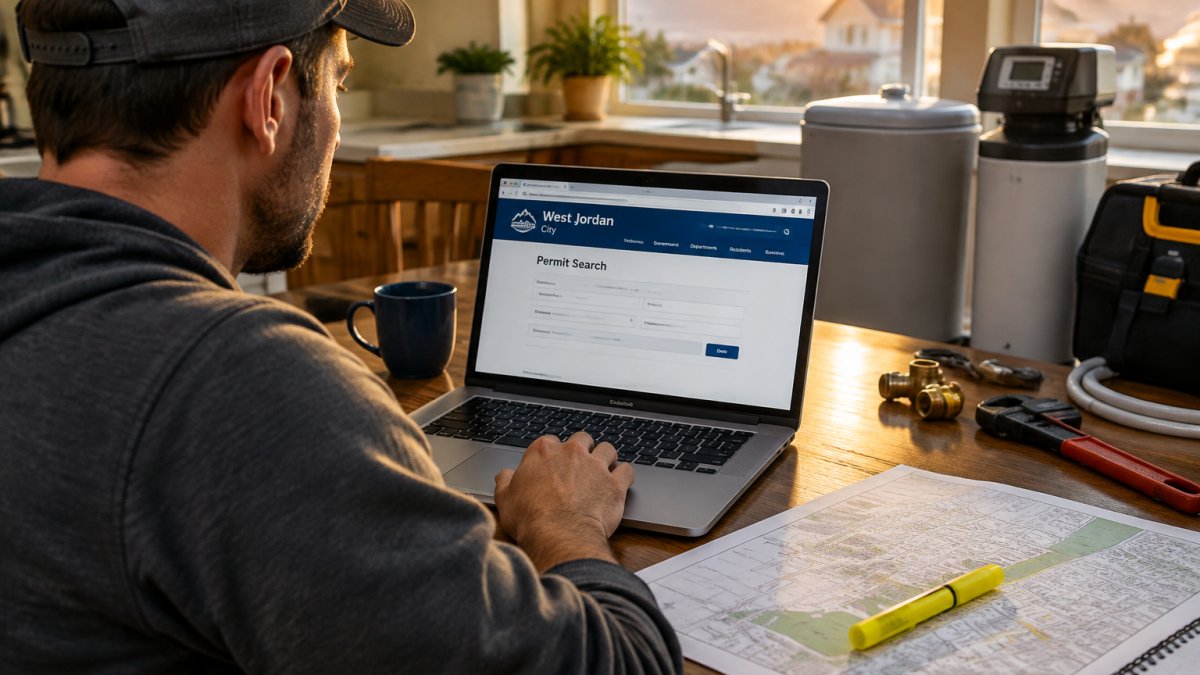
What a Residential Permit Record Actually Tells You
A residential permit record tells you the address, the permit type, the issue date, the valuation, and the inspection history. The inspection history is the useful part. A permit that has passed framing and rough-in inspections is further along than one issued last month with no activity.
Look for the plumbing rough-in inspection. That is the stage where supply lines, drain lines, and any softener loop are in the walls before drywall closes them. If the rough-in has passed and the record shows no final inspection, the home is moving toward finish-out. That is your window.
Filtering Permits Down to Homes Nearing Move-In
Filter in this order:
- Keep single-family residential permits only; drop commercial and remodels
- Sort by issue date and drop anything issued in the last few weeks
- Check inspection history for a passed rough-in
- Flag records with a passed framing or insulation inspection as closer to finish
- Group the survivors by street so one drive covers several homes
A common mistake is skipping the street grouping. Three homes on the same block are worth more than three scattered addresses across the valley, because one trip reaches all of them.
Turning Permit Stages into Water Softener Installation Leads
Permit stages map to sales stages, and the mapping is where most reps leave money on the table. A passed rough-in means the loop and drain are set, so the conversation is about equipment selection and scheduling.
Here is how we would work the stages:
| Permit Stage | What It Signals | Your Move |
|---|---|---|
| Permit issued | Project just started | Log the address, do not visit yet |
| Rough-in passed | Plumbing in walls, loop set | Confirm loop and drain, quote equipment |
| Insulation or drywall passed | Interior closing up | Set a target install window |
| Final inspection pending | Home nearing completion | Plan outreach around move-in |
| Final passed | Home essentially done | Last call before the owner moves in |
The table is the easy part. The harder skill is reading the inspection record accurately, because a permit portal shows dates and statuses, not a clean "ready" flag. A few habits make the reading reliable:
- Read the inspection list, not just the status. A permit can show "active" while the last inspection was months ago. The date of the most recent passed inspection is a better signal than the permit's overall status.
- Know which inspection is which. Framing, rough-in (plumbing, mechanical, electrical), insulation, drywall, and final are separate inspections in most jurisdictions. A passed plumbing rough-in is the one that matters for softener readiness; a passed framing inspection tells you the project is moving but says nothing about the loop.
- Treat a long gap as a question, not a green light. A permit with a passed rough-in and no activity for a long stretch may be stalled, a spec home waiting on a buyer, or simply a record that has not been updated. A common pattern is to group these separately and check them on the ground before planning a visit.
- Group by street and by builder. Homes on the same block from the same builder tend to move through inspections on a similar schedule, so one site visit can confirm several records at once.
For a deeper walkthrough of the permit-to-lead process, see how to find new construction leads from public building permits. And if water softeners are your main trade, our guide on finding water softener new construction leads in Utah goes further into the specifics.
Watch out: a permit record is a public filing, not a promise. Inspection dates can lag, statuses can be entered late, and a "final passed" record does not mean the owner has moved in.
Planning Outreach Around Estimated Move-In Timing
Timing beats volume in this trade. A softener quote that lands two weeks before move-in gets read. The same quote six months early gets filed and forgotten.
Build a simple calendar around your filtered list. For each street, note the estimated window and schedule a first touch a few weeks ahead of it. Then a second touch closer in.
A common mistake is over-mailing early-stage permits. If the rough-in was just passed, the homeowner has not picked flooring yet and is not shopping for a softener.
The other mistake is treating the list as a contact database. It is not.
Why a Water Softener Belongs in New Construction Plumbing Planning
Hard water is the reason. Hard water is a common reason homeowners add a softener. Hardness is measured in grains per gallon, and the calcium and magnesium in hard water leave scale buildup in pipes, water heaters, and fixtures over time. In a new build, the softener decision belongs in the plumbing plan, not in a panic call after move-in.
Most service pages stop there. The useful detail for builders and plumbing contractors is what "ready" actually means at rough-in, because that is the stage where the decision is cheap to make and expensive to reverse.
Rough-In, Loop, and Drain: What Builders Need Before Drywall
Three things need to be in place before drywall closes the walls:
- A softener loop: a capped supply line run to the planned softener location, usually the garage or utility area. The loop is a bypass: water enters the softener, treated water returns to the house supply.
- A drain connection: a standpipe or floor drain within reach of the brine tank. Brine tanks discharge during regeneration, and the discharge line needs an air gap and a trap per local plumbing practice. A floor drain in the same utility closet is the simplest answer; a standpipe works if it is sized and trapped correctly.
- A power source: a nearby outlet for the control valve. Most control valves run on a low-voltage transformer plugged into a standard outlet, so a dedicated circuit is not usually required, but an outlet within cord reach of the planned location is.
Get those three right and installation is a short job. Miss the drain and you are running new pipe through a finished wall. This is also where a whole house filtration setup or a reverse osmosis unit at the kitchen sink gets planned, because both want space and a connection point. A reverse osmosis unit under the sink needs a feed line, a drain saddle, and an outlet; planning those at rough-in avoids cutting into a finished cabinet later.
Watch out: a loop that is capped but not valved, or a drain that is out of reach of the brine tank, turns a one-hour install into a drywall repair. Walk the utility area before the rough-in inspection, not after.
Sizing the System Before the Walls Close
Water quality testing before the system is sized matters. Hardness, iron, and sediment levels decide whether you need a softener alone, a sediment filter ahead of it, or a combination. Sizing follows from the test and from the home's flow rate, not from a guess.
For a new build, the practical sequence is: test the water source the home will actually use, size the unit to the fixture count and expected occupancy, confirm the loop and drain match the chosen unit's connections, and leave the bypass valves accessible.
Using the Herriman New Construction Street List as Your Salt Lake County Test
Herriman is the covered example for Salt Lake County. If you want to see what the format looks like before committing to anything, the Salt Lake County building permits page explains what the weekly list includes.
Herriman is a practical place to start: a rep can test the whole approach on one covered city before expanding.
For other Salt Lake County cities, the method still works: pull that city's public permits, filter by stage, and group by street. When you are ready to see the covered example in detail, the Herriman building permits page shows what the list covers.
Get the Free Weekly Street List for Salt Lake County
The whole method above runs on one input: knowing which streets are nearing move-in. You can build that yourself from city permit portals, and plenty of reps do.
New Home Watch does that reading for you and emails the result. The free weekly street list for Salt Lake County arrives by email, no card required.
If you want to see the format first, the free weekly street list page shows what lands in your inbox.
Two things to keep straight. The list is streets and estimated timing from public permits, not homeowner contacts, and the timing is an estimate, not a confirmed date. That is enough to plan a route and a week.
Homes under permit now will need water treatment at move-in.
Frequently Asked Questions
How can water softener installers find new construction leads in West Jordan?
Start with West Jordan's public building permit records and pull residential permits for single-family homes. Look for permits that have moved past framing into later inspection stages, since those homes are closer to move-in. Group the addresses by street so one trip covers several homes. New Home Watch does the same work from public permit records and emails a free weekly street list; Salt Lake County coverage currently covers Herriman, so West Jordan installers can pair their own permit search with the Herriman list to test the approach.
What information can public building permits provide to a water softener installer?
A residential permit record typically shows the address, permit type, application and issue dates, and inspection milestones. That tells you a house exists and roughly how far along it is. It does not give you homeowner names, phone numbers, or a confirmed move-in date. Treat the stage as a signal for when to plan outreach, not as a promise the family will be in that week.
Does New Home Watch provide a West Jordan street list?
No. Salt Lake County coverage is currently Herriman, built from City of Herriman permits. West Jordan is not a covered street list, so use West Jordan's own public permit search for that city and treat Herriman as the covered example of how the weekly list works. You can get the free weekly street list for Salt Lake County by email with no card at newhomewatch.net/free?market=salt-lake-county.
When should a water softener contractor contact a new construction homeowner?
Aim for the window after the home is dried in and before the family settles in, when a softener can still be planned around the plumbing rather than retrofitted. Because permit stages only estimate that window, work the street in order of inspection progress and leave a door hanger or note where no one answers. Plan a second pass a couple of weeks later rather than assuming a single visit lands.
